Research
Executive Education
Quick Links

September 19, 2026
Flipping the Menu: How a Local Burger Joint Found a "Blue Ocean" in Dips


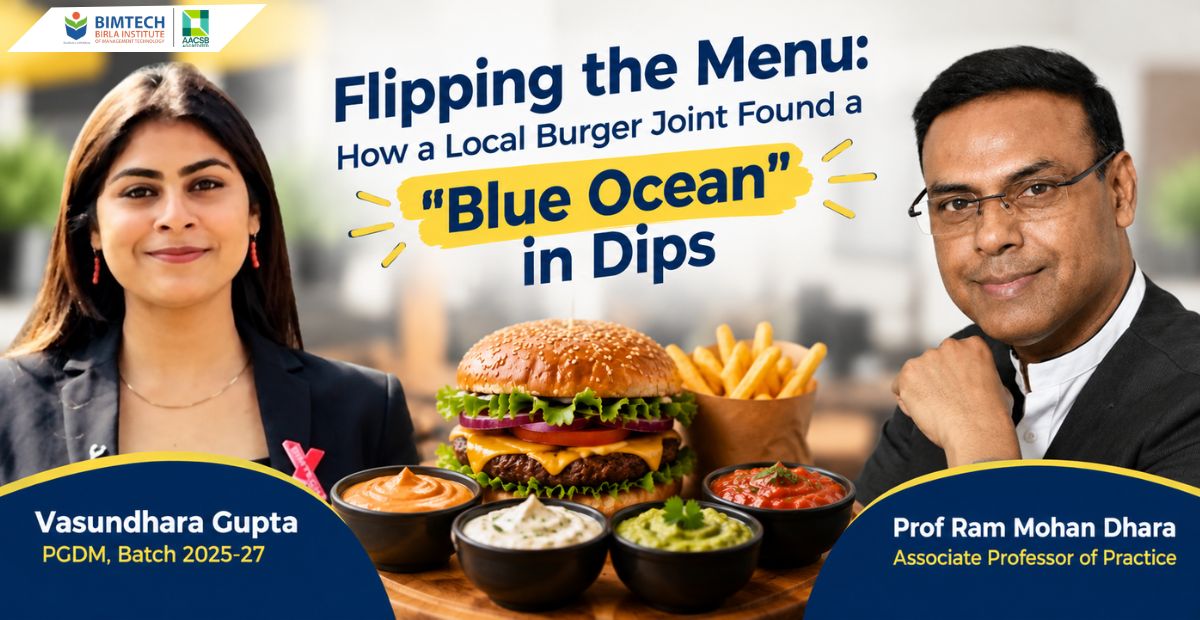
The fast-food industry is the textbook definition of a Red Ocean. It is a highly saturated and fiercely competitive market where rivals fight for shrinking profit margins. Globally, the burger is the undisputed king of this arena. Every fast-food giant fights a bloody and never-ending price war over who has the juiciest patty, the softest bun, or the most efficient supply chain.
This presents a massive barrier to entry. How does a new local player survive in a market dominated by multi-billion-dollar giants with decades of operational dominance?
The answer can be found in Noida at a relatively unassuming restaurant called D!pr. They survived and thrived not by engineering a better burger, but by realizing that the burger did not need to be the main event at all. They made their wide array of gravies and dips the star. The burger merely serves as an edible vehicle to savour on the gravies.
This Localied example offers a masterclass in market disruption. Strategy sometimes is not to just change the rules of the game but is playing it better than your competitors.

Escaping the “Red Ocean”
To understand this, it is important to look at the Blue Ocean Strategy formulated by W. Chan Kim and Renée Mauborgne. The concept is straightforward - rather than race for dwindling resources, in the profit landscape, innovators who win are those who make an uncontested space for themselves.
If D!pr had been a typical burger joint, they'd be in a losing battle against brands with proven established supply chains, huge marketing budgets and a massive market share.
Even if their burger was objectively better, convincing a customer to switch loyalties based on the patty or bun quality alone would have been an expensive and exhausting fight.
By shifting the competition entirely away from the patty or bun onto an array of specialized dips and sides, D!pr immediately stepped out of the Red Ocean. They are not competing against established fast-food chains anymore rather they’re playing a completely different game. When a customer would crave a customized and flavour- heavy experience, the established standard chains simply would not stand a chance to compete.
Geographic Arbitrage and the Flavour Matrix
The inception of this concept showcases a brilliant approach to product development. The founder says thathe drewinspiration from a piece of contenthe sawfeaturing “Birria”burgers (Mexican dish) savoured by dipping them in a rich meat broth.
Taking a successful concept from a foreign market and adapting and customising it to a local demographic is a strategic framework known as Geographic Arbitrage or Glocalization. The
founder noticed a crucial cultural overlap, where Mexico has its broths, the Indian palate is conditioned to appreciate richness in flavours and diverse gravies.
Another thing worth taking note is that the brand did not just stop at localizing the product with Indian flavours. At the stage of the menu design, they broadened the concept to be quite a highly scalable 4 quadrant global flavour matrix. By offering American Cheddar, Italian The restaurant could turn over a leaf and become a Marinara, Indian Butter Makhani, and Asian Gochujang. They turned the standard menu into a menu full of global flavour exploration. This ensured that they could serve a variety of customer types, satisfy their appetites and at the same time appeal to much broader audience.
Core Competency Inversion
Management classrooms teach us that businesses are to be taught to defend themselves by any means against their core competencies. This is the main thing that D!pr does the best, allowing them to commoditize the rest. Sauces are the low man on the totem pole when it comes to making money in the fast food industry.
These are often stuffed at the bottom of take-out bags, handed out as a gift, and usually not a big part of the main value of the take-out. Whether you know it, or not, D!pr did a brilliant operational pivot, what we refer to as Core Competency Inversion.
They took the lowest on a traditional menu and make it their highest value proposition. In so doing, they turned their entire supply chain and marketing upside down. The most costly, and most complex to master, of the burger is put in the background. So long as it makes the burger taste good enough for the dip it's accomplished its task fairly well. Research, developmentand marketing funds are, instead, invested in building up a large library of sauces that are dificult for other manufacturers to copy.
Consumer Psychology and the “IKEA Effect”
The operational inversion is more for the company than it is to save itfrom a price war. It alters the buyer's funnel based on a strategic user engagement approach. According to the founder himself, there are three steps to eating Dipr Burgers – dip the burger in the gravy, dip in crunchy sides (called “crispers”) then take a bite and enjoy. The customer no longer has to go to the trouble of unwrapping a set meal, but is now creating a meal of his/her design. They can have global dips and add-on-sides of their choice such as crispy fried onions or bacon. It might seem like friction at first glance, but if a customer has to go to three steps to eat a burger, it's a good idea.
This particular kind of friction, however, enhances the perceived value of a meal. This is the psychological principle of “IKEA Effect”. It is a cognitive error that gives an exaggerated value to products in which the consumer is partially involved in their production or personalization. As customers are engaged in creating their own meal profile in this interactive dipping and crumbing, the brand memorability increases. The food is distinctly their own. No longer passive consumer, they are now active consumers. They are involved in an interactive and interesting meal time experience. The operational inversion is more to the company than a
fight against a price war. It changes the way a buyer approaches the buying process, in a way that is beneficial to the user. It changes the path of how the buyer goes through the buying process, in a way that is advantageous to the user. The founder says that Dipr Burgers are eaten in three parts: dipping in gravy, dipping in crunchy sides known as “crispers”, and lastly eating and enjoying!
The customer is no longer merely selecting from a collection of ready-made meals, but rather assembling a personalized morsel. They can choose global dips and add-on-sides of their preferences such as crispy fried onions or bacon. It might appear to add friction, since at first glance it looks like you'll have to walk the customer through a three-step process to eat a burger. But the kind of friction they are having actually enhances the perceived value of the meal! This is the psychological effect known as “IKEA Effect”.
It's a thinking error that occurs when consumers undervalue goods and services that they partially make or customize themselves. This active “dipping and crumbing” process that allows customers to construct their own meal profile increases brand memorability. The meal is really a special one, all their own. No longer consuming a product on a passive basis. They are enjoying an active and interactive meal time.
The Takeaway
Some of the best business lessons can be learned from outside of Silicon Valley tech companies or Wall Street financial moves. These sometimes are inspired by brilliant local observations. True innovation doesn't always mean creating a brand new technology or a revolutionary product; that's the lesson that D!pr has learned in a saturated market. Sometimes, market disruption is just doing a little research into the current business environment, breaking a few rules and posing a very basic question- What if the sidekick becomes the hero?
References:
- Kim, W. C., & Mauborgne, R. (2004). Blue Ocean Strategy. Harvard Business Review.
- Norton, M. I., Mochon, D., & Ariely, D. (2012). The IKEA effect: When labor leads to
 Back