Research
Executive Education
Quick Links

September 9, 2026
Where did the time Go?


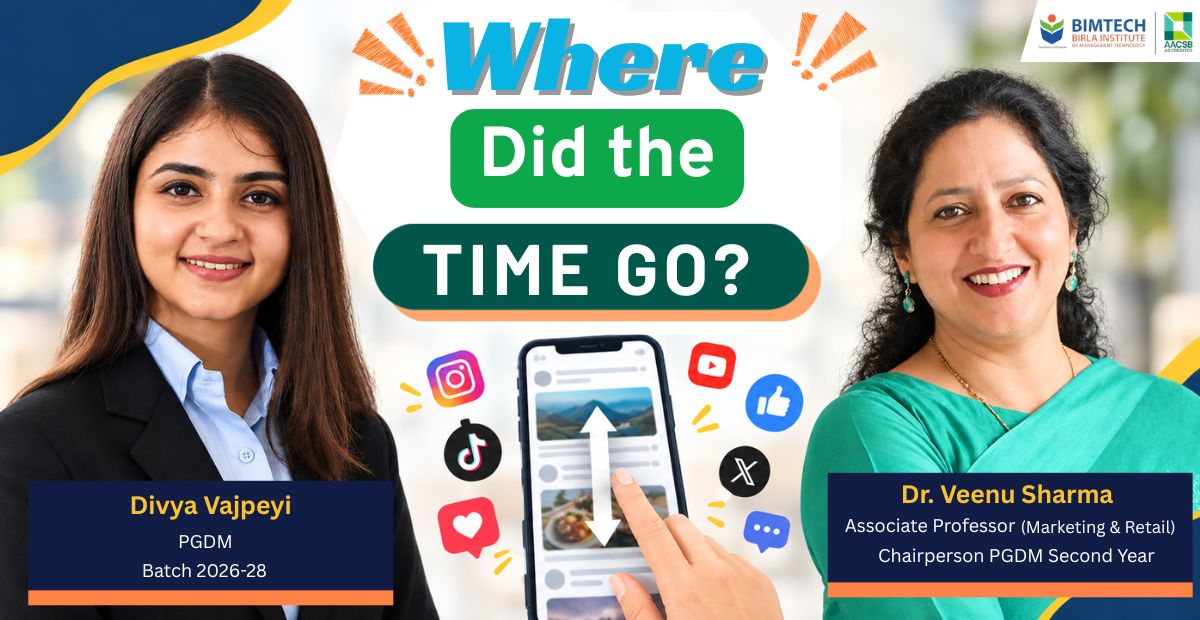
It is half-past midnight. In ten minutes’ time, you promise yourself, you will put down your phone and get back to your pending work. You open Instagram, click on some Reels, chuckle at a funny video, skip an uninteresting one, and continue scrolling in the hope that the next one will be better. When you finally look at the clock, you are shocked to realize it is already 3:00 a.m. The work remains unfinished, and now you are left with a sense of guilt. If doomscrolling rarely leaves us satisfied, what makes us continue doing it?
The answer has much to do with the way modern technology works. Attention is the new oil, and in today’s digital economy, social media companies compete intensely for it. There is a direct relationship between how much time users spend on a platform and how much revenue the platform can potentially generate through advertisements, engagement, and consumer data. As a result, digital platforms are designed to keep users engaged for as long as possible.
This idea is not entirely new. Nobel Prize-winning economist Herbert Simon observed decades ago that an abundance of information creates a scarcity of attention. Today, this idea forms the basis of what we call the attention economy, where human attention has become one of the most valuable resources.
But why are we so willing to give away our attention?
Often, there is something we know we need to do but would rather avoid. It may be studying for an exam, completing an assignment, responding to emails, or finishing a difficult project. Such tasks require effort and concentration. Scrolling, on the other hand, is easy and enjoyable. It allows us to temporarily escape uncomfortable or demanding tasks without requiring much effort. In this sense, doomscrolling becomes an easy form of procrastination.
However, procrastination alone does not explain why we can scroll for hours. Social media platforms are specifically designed to keep us emotionally invested. One moment, Instagram may show you a funny AI-generated video of a German Shepherd dancing to the latest Bollywood song; the next may be a tutorial on filing income tax. You quickly skip the boring video, hoping the next one will be as entertaining as the first.
This pattern is based on what psychologists describe as variable rewards. Every swipe carries uncertainty. You do not know whether the next Reel will be boring, funny, shocking, informative, or perfectly suited to your interests. That uncertainty keeps you curious. You may watch dozens of ordinary videos simply because you believe the next one could be worth watching.
Businesses understand this behaviour well. Features such as infinite scrolling, autoplay, personalized recommendations, and notifications reduce the number of opportunities users have to consciously decide whether they want to continue. Algorithms constantly learn from what we watch, like, share, skip, and search for. This information is then used to recommend content that is increasingly likely to capture our attention.
The business logic is simple: more attention leads to more engagement, more engagement creates more opportunities for advertising, and more advertising can generate more revenue. Our attention, therefore, has economic value.
This raises another important question: is constant exposure to highly stimulating digital content changing the way we interact with ordinary life? Activities such as reading a book, having a conversation, studying, or even watching a movie require sustained attention. Social media, however, gives us something new every few seconds. Over time, constantly switching between short pieces of content may make slower activities feel less exciting by comparison.
The problem can become even stronger late at night. After making countless decisions throughout the day, we may have less mental energy available to resist distractions. A five-minute break can therefore easily turn into an hour of scrolling.
Breaking this cycle requires more than simply telling ourselves to “use the phone less.” It requires becoming conscious of how our attention is being captured. Setting limits on social media use, turning off unnecessary notifications, keeping phones away while studying or working, and intentionally spending time on meaningful offline activities can help us regain control.
Doomscrolling has entered almost every part of our lives—while waiting for a friend, travelling, taking breaks, eating, or even sitting with family. Moments that were once opportunities to observe, think, talk, or simply be bored are increasingly filled with screens.
Understanding attention design is therefore the first step towards reclaiming our attention. Algorithms may be extremely effective at capturing it, but they do not have to dictate how we spend our entire lives. We can consciously choose to look up, talk to people, spend time with family and friends, read, exercise, pursue hobbies, or simply experience the world around us.
For those of us who may become managers and marketers, there is another lesson. Businesses will continue competing for consumer attention, but long-term success should not depend on exploiting psychological vulnerabilities. Responsible marketing means using people's attention to provide genuine value rather than simply maximizing the amount of time they spend on a platform.
Ultimately, our attention is precious because our time is limited. The real question is not whether technology can capture our attention, it certainly can. The question is whether we allow it to decide what deserves our time.
 Back