Research
Executive Education
Quick Links

September 14, 2026
Will Premiumization be a Game Changer in Quick Commerce Industry?


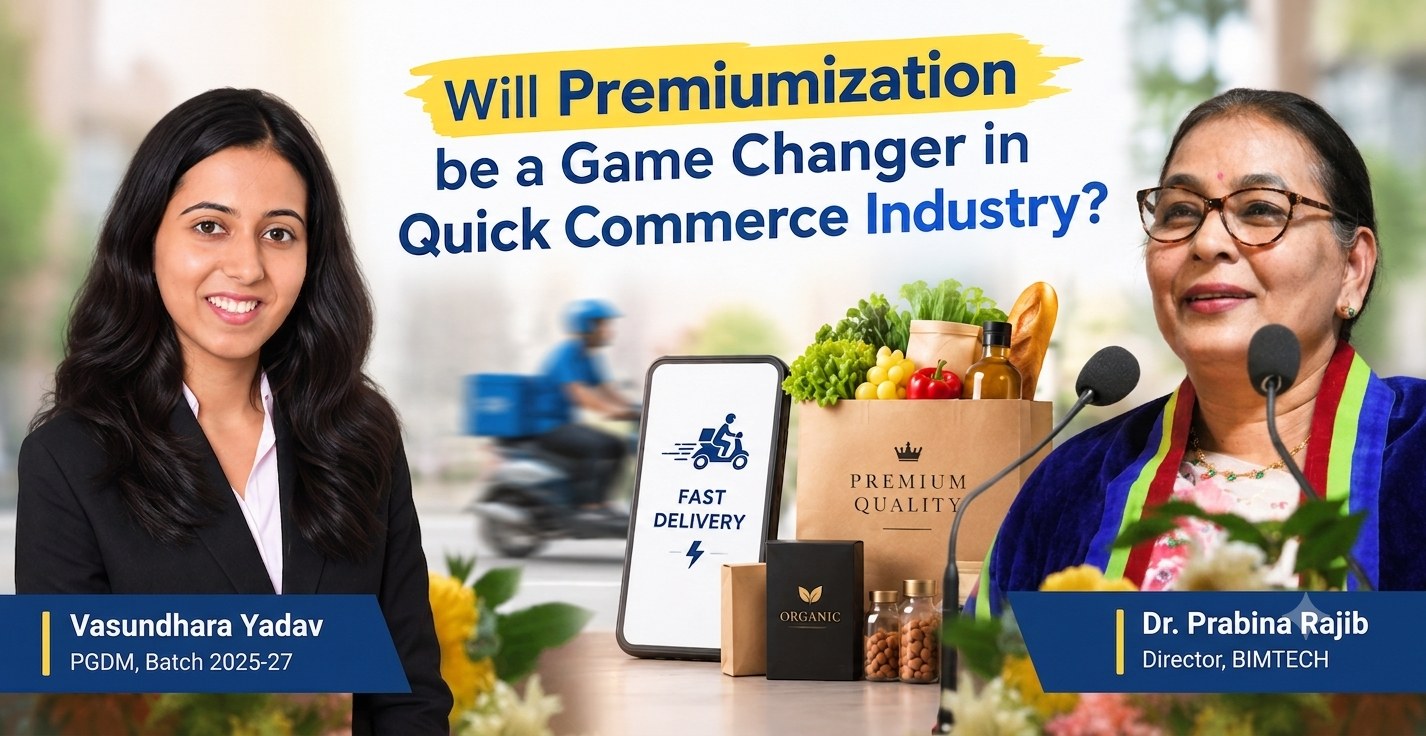
Remember when quick commerce meant opening Blinkit, Zepto or Swiggy Instamart to order milk, bread, chips or coriander because you did not want to step out of the house. Today, these platforms are attempting to evolve from just a last minute grocery app to offering premium food, beauty, and lifestyle products with the expectation that users will not only purchase from them more often, but also increase their average cart size in the process.
The apps that promises groceries at your doorstep in minutes are now asking a very different question, what if customers also wanted artisanal cheese, imported pasta, premium skincare or gourmet snacks delivered just as quickly?
This is precisely the concept of premiumization in quick commerce and nearly all of the major players are attempting to achieve the same goal. But there is a catch, premiumization may be easy to launch, but it will not be easy to make profitable. India’s quick commerce market was built around frequency; milk, eggs, vegetables and snacks are purchased regularly, making them ideal for a business model built around speed and convenience. The premium products are different because they are purchased less often, cost more, and raise concerns regarding the quality, freshness, authenticity, and experience amongst the customers..
Yet the opportunity is too attractive to ignore.
Beauty and personal care have become one of the clearest examples. According to Redseer estimates, the top three quick commerce platforms together reached approximately ₹9.5 thousand crore in annualized beauty and personal care GMV by early 2026 which is now growing at roughly 90%. This has revealed that quick commerce is not just confined to core products, but it's now gaining value in higher value and premium categories too. Hence, the platforms are coming in and everyone wants a slice of the premium basket.
Blinkit has recently added a new premium grocery offering called Gourmet comprising of different high end bakery products, artisan breads, cheeses and gourmet items to underscore the industry's trend beyond everyday products to more special and premium grocery items.
Zepto is ready to launch a separate section for imported, gourmet and premium grocery products named Select. The company has already tried the idea in certain areas and is searching for growth.
Swiggy Instamart is also expanding its grocery offerings beyond the usual grocery, providing a choice of top notch fresh produce and gourmet food items on the platform.
Now the competition is getting even more intense with Amazon Now, which recently expanded fast delivery in premium and curated segments and Flipkart Minutes coming in with its private label proposition in the premium and gourmet grocery segment.
Then there is FirstClub, on a more targeted path, rather than just adding “premium” products to its mass market platform, it is creating its proposition around quality driven grocery. The concept of investing seems to resonate with investors as well, as FirstClub managed to raise some ₹25 crore in June 2026 at a valuation of ₹5.5 crore.
It's evident that premiumization is not only a side bet, but an actual strategy for fast commerce. It's so attractive because it's easy to see the potential for higher revenue per order and better unit economics.
Having been competing for years to get customers, quick commerce companies have gone so far as to open dark stores and compete for market share, but now it is progressively harder to get new customers. Therefore, it is not enough to just increase the amount of low value orders; profitability needs to be addressed as well. Premium products offer another route, instead of convincing a customer to place three more orders, platforms can try to make the existing order worth more. But that is where the “cakewalk” ends, premium grocery requires the right products, the right customers and, most importantly, the right inventory in the right location.
A premium customer may not forgive a poor quality produce, damaged packaging or an unavailable product as easily as someone ordering a ₹30 packet of chips. Real estate is another challenge, a premium product needs to be concentrated in an affluent neighborhood, where rents are already expensive. A premium proposition operating through a dedicated network is very different from simply adding a premium shelf to thousands of existing dark stores.
Then the bigger question is, can premiumization actually improve profits?
This is where the industry’s opportunity needs to be tested against reality. Blinkit has built huge scale, with targeting more than 2,200 dark stores by the end of 2026, yet premiumization is still being tested only on a small part of that network. At the same time, the broader quick commerce industry is still working towards generating sustainable profits. Swiggy Instamart has continued to report negative contribution margins in 2026, although its economics have improved significantly in the June 2026 quarter. This tells us something more interesting, premiumization has already proven that customers are willing to spend more, but will the platforms can consistently earn more, it's not yet guaranteed.
The next phase of quick commerce may therefore not be about who can deliver premium cheese in ten minutes, but about who can do it without letting inventory, rent, wastage, sourcing and fulfilment costs eat away the premium. The leaders may not necessarily be the platforms with the biggest dark store networks instead they could be the ones that understand where consistent demand exists, curate the right assortment, maintain quality and build a supply chain specifically designed for premium consumption.
So, will premiumization be the next game changer for Indian quick commerce?
Potentially Yes, but it will not be a cakewalk. The industry has already proven that Indians will pay for convenience. But the next challenge is to prove that, will they pay enough for premium convenience to make the economics work?
That may be the real battle for quick commerce in the coming years.
 Back